
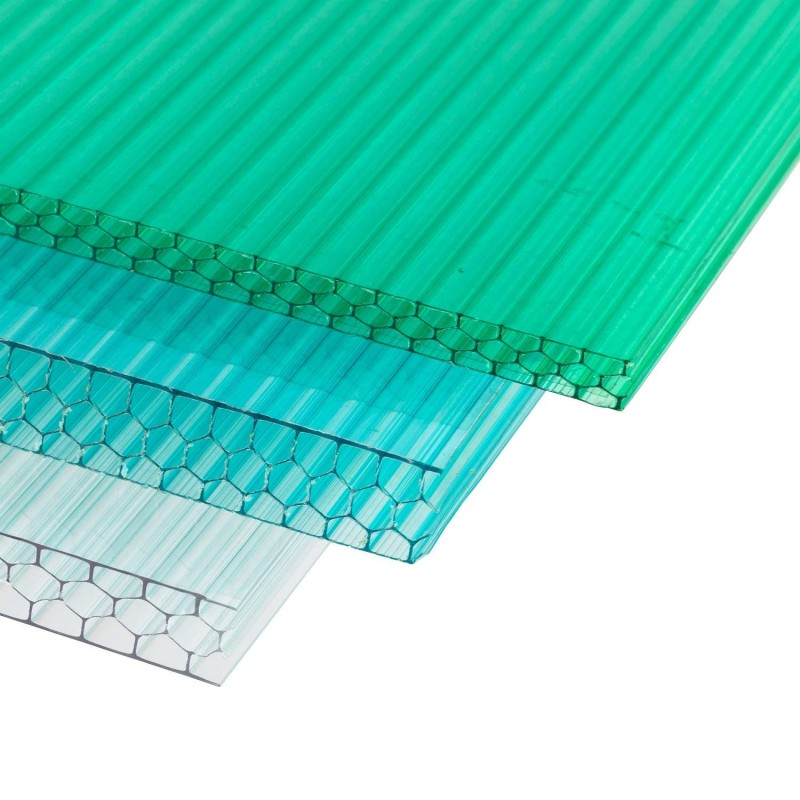
Comprehensive Guide: Differences Between Double-Layer and Multi-Layer Polycarbonate Sheets (Four-Layer, Honeycomb, X-Type)
Polycarbonate Sheets (PC Sheets) have become a preferred material in construction, agriculture, and industrial applications due to their lightweight, impact resistance, and excellent light transmission. Among the various types available, double-layer and multi-layer (four-layer, honeycomb, X-type) Polycarbonate Sheets are the most widely used. This article provides a detailed comparison of their key characteristics, performance parameters, application scenarios, and answers common customer questions to help you make informed purchasing decisions.
**
Note: The image link may not be accessible due to technical limitations, but it typically shows a side-by-side comparison of double-layer and multi-layer Polycarbonate Sheet structures.
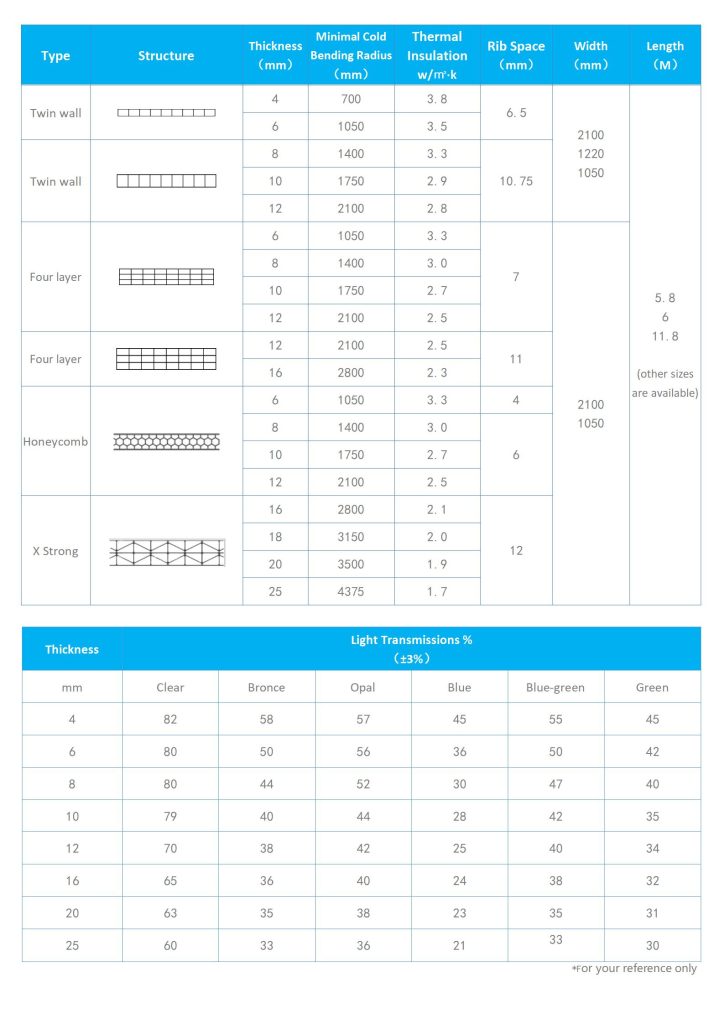
Core Performance Comparison Table
| Performance Indicator | Double-Layer Polycarbonate Sheet | Multi-Layer Polycarbonate Sheet (Four-Layer, Honeycomb, X-Type) | Key Difference Analysis |
| Rigidity (Support Performance) | 10mm thickness: Purlin spacing ≤ 0.9m (meets standard wind/snow load resistance) | 10mm thickness: Purlin spacing ≤ 1.1m (maintains same wind/snow load resistance) | Multi-layer sheets have 22% higher effective purlin spacing capacity due to their reinforced internal structure, reducing installation costs for large-span projects |
| Minimum Bending Radius | 175 × sheet thickness (e.g., 10mm sheet: 1750mm radius) | 175 × sheet thickness (consistent with double-layer sheets) | No difference in flexibility, both suitable for curved roofing and enclosure projects |
| Light Transmission Rate | 85-90% (for clear, 6-10mm thickness) | 80-85% (for clear, 10-25mm thickness) | Multi-layer sheets have a 5% lower light transmission due to additional internal layers, but still maintain excellent natural lighting performance |
| Sound Insulation Performance | 30-35 dB (for 10mm thickness) | 33-40 dB (for 10mm thickness) | 3-5 dB improvement in multi-layer sheets, effectively reducing external noise (e.g., traffic, rain) in indoor spaces |
| Thermal Insulation Performance | Thermal conductivity (λ) ≈ 0.06 W/(m·K) | Thermal conductivity (λ) ≈ 0.045 W/(m·K) | 5℃ better heat retention in multi-layer sheets, reducing energy consumption for heating/cooling in greenhouses and buildings |
| Price (Per Square Meter) | $15-25 (depending on thickness and quality) | $15.45-25.75 (3% higher than double-layer sheets) | Slight price premium for multi-layer sheets, offset by long-term energy savings and reduced installation costs |
| Weight (Per Square Meter) | 1.2-2.0 kg (6-10mm thickness) | 1.8-3.5 kg (10-25mm thickness) | Multi-layer sheets are heavier but still 50-70% lighter than glass, ensuring easy transportation and installation |
Detailed Performance Analysis
- Rigidity & Load-Bearing Capacity:
The internal structure of multi-layer Polycarbonate Sheets (such as honeycomb or X-type grids) distributes stress more evenly, making them more rigid than double-layer sheets. For example, in greenhouse construction with a span of 10 meters, double-layer sheets require 11 purlins (spaced 0.9m apart), while multi-layer sheets only need 9 purlins (spaced 1.1m apart), reducing the number of structural components by 18%. This not only lowers material costs but also shortens construction time.
- Thermal & Sound Insulation:
Multi-layer Polycarbonate Sheets feature closed-cell structures that trap air, enhancing thermal insulation. In northern China’s winter, a greenhouse covered with 10mm multi-layer sheets can maintain an internal temperature 5-8℃ higher than one with double-layer sheets, reducing heating costs by 20-30%. In terms of sound insulation, the additional layers absorb sound waves, making multi-layer sheets ideal for noise-prone areas such as highway sound barriers, office building enclosures, and indoor swimming pools.
- Light Transmission & Durability:
Both types of sheets maintain high light transmission, but double-layer sheets are preferred for projects requiring maximum natural light (e.g., solariums, display windows). It’s important to note that durability depends on the quality of the UV coating and base material, not the number of layers. Zhejiang Aoci’s Polycarbonate Sheets undergo 10,000 hours of weathering aging tests, ensuring resistance to yellowing and degradation for 10-15 years outdoors.
Common Customer Questions & Answers
| Question | Detailed Answer |
| Are multi-layer Polycarbonate Sheets more durable than double-layer ones? | No. Durability is determined by the UV coating thickness (preferably ≥50μm) and the purity of the PC raw material (virgin PC resin is better than recycled material). The outermost layer of both sheet types bears the brunt of UV radiation and environmental wear, so adding internal layers does not extend service life. Choose products with certified UV resistance (e.g., CE, ISO 9001) for long-term reliability. |
| Is it cost-effective to invest in multi-layer Polycarbonate Sheets? | It depends on your location and application: Northern Regions/Cold Climates**: Multi-layer sheets are cost-effective due to superior thermal insulation, reducing heating costs in greenhouses, livestock sheds, and residential enclosures. >- Southern Regions/Warm Climates: Double-layer sheets are sufficient for most applications (e.g., carports, balcony covers) and offer better value for money. >- Large-Span Projects: Multi-layer sheets reduce purlin requirements, making them cost-effective for stadiums, exhibition halls, and industrial workshops. |
| What types of multi-layer Polycarbonate Sheets are available, and how to choose? | Multi-layer sheets are classified by internal structure: Structure Feature |

