Does Higher Light Transmittance Mean Better Quality of Polycarbonate Sheet?
Is a Polycarbonate Sheet with Higher Light Transmittance Equivalent to Premium Quality?
The straightforward conclusion is negative. Light transmittance is merely one of numerous physical indicators of polycarbonate sheet and can never be adopted as the single benchmark to evaluate the overall quality of finished polycarbonate sheet products.
During the procurement phase of polycarbonate sheet products, most purchasers are confused about the identification standards for qualified panels. The industry widely recognizes the principle that quality matches price, yet most clients lack systematic knowledge to conduct comprehensive quality screening. So what comprehensive dimensions should inspectors and buyers rely on to accurately assess product quality?
The quality grade of polycarbonate sheet is jointly determined by three irreplaceable core indicators: the purity of virgin polycarbonate raw materials, nominal areal weight per square meter, and the structural integrity & thickness of co-extruded UV anti-aging coating. A complete, multi-dimensional inspection covering all three metrics is mandatory to deliver objective quality judgment.
For transparent non-tinted polycarbonate sheets with identical nominal thickness and standard areal weight specifications, relatively higher light transmittance merely reflects fewer impurity particles, less recycled filler and cleaner virgin resin inside the panel substrate. It is critical to note that this correlation between transmittance and raw material purity is only valid for fully transparent polycarbonate sheet variants.
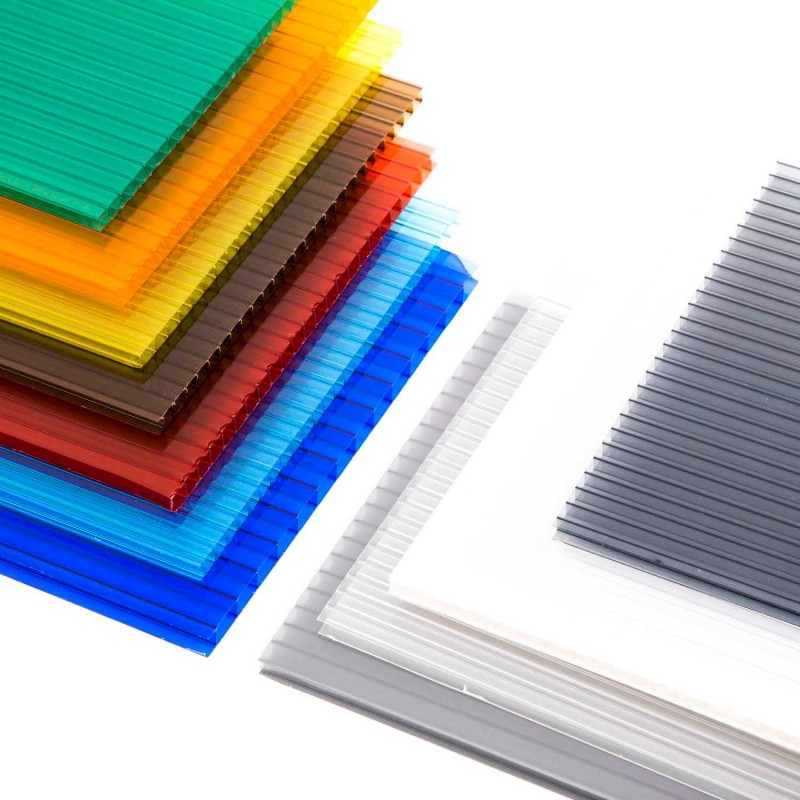
For colored, tinted, matte or pigment-modified polycarbonate sheets, light transmittance is an artificially customizable parameter controlled by pigment addition ratios during extrusion processing. Deep color formulas inherently absorb more visible light, which inevitably cuts down light transmittance figures. In such cases, transmittance data loses reference value for judging raw material purity entirely.
In-depth Analysis: Why Light Transmittance Cannot Act as the Sole Quality Evaluation Criterion
We can illustrate this logic with a typical 8 mm transparent polycarbonate sheet specification widely used in roofing and daylighting projects. The core parameter comparison between standard compliant products and non-standard inferior products is shown in the table below:
Core Parameter Comparison of Standard vs Non-Standard 8mm Polycarbonate Sheet
| Parameter Index | Standard Compliant Polycarbonate Sheet | Non-Standard Inferior Polycarbonate Sheet |
|---|---|---|
| Nominal Thickness | 8 mm | 8 mm (false nominal specification) |
| Actual Effective Thickness | Full 8 mm | Only 7 mm |
| Areal Weight per Square Meter | 1.4 kg | Merely 1.05 kg |
| Light Transmittance | ≥75% | ≥75% |
The underlying physical principle is clear: light transmittance presents an inverse correlation with the substrate thickness and areal weight of polycarbonate sheet. Under the same raw material purity, the thicker the panel structure or the higher the per-square-meter weight, the more light will be blocked and refracted by the internal resin layers, resulting in a lower final light transmittance value.
As shown in the table, even with a 12.5% reduction in actual thickness and a 25% drop in areal weight, the non-standard polycarbonate sheet can still achieve the same light transmittance level as the standard product. This fully proves that light transmittance cannot reflect the structural integrity, raw material dosage and overall quality of the polycarbonate sheet.
Additional Data Specification Table for Core Quality Indicators
| Core Quality Indicator | Standard Requirement for Premium Polycarbonate Sheet | Risk of Inferior Products |
|---|---|---|
| Raw Material Purity | 100% virgin polycarbonate resin (no recycled filler) | Mixed with recycled materials, impurity particles |
| UV Protective Coating | 50μm co-extruded anti-UV coating on both sides | No UV coating, or only thin single-side coating |
| Service Life | 10+ years of outdoor service under standard use | Yellowing, cracking and aging within 1-3 years |
Given the above logical and practical production facts, light transmittance can only be treated as an auxiliary reference indicator in polycarbonate sheet quality inspection. It cannot function as a decisive, conclusive standard to differentiate high-quality standard panels from substandard inferior polycarbonate sheet products.