
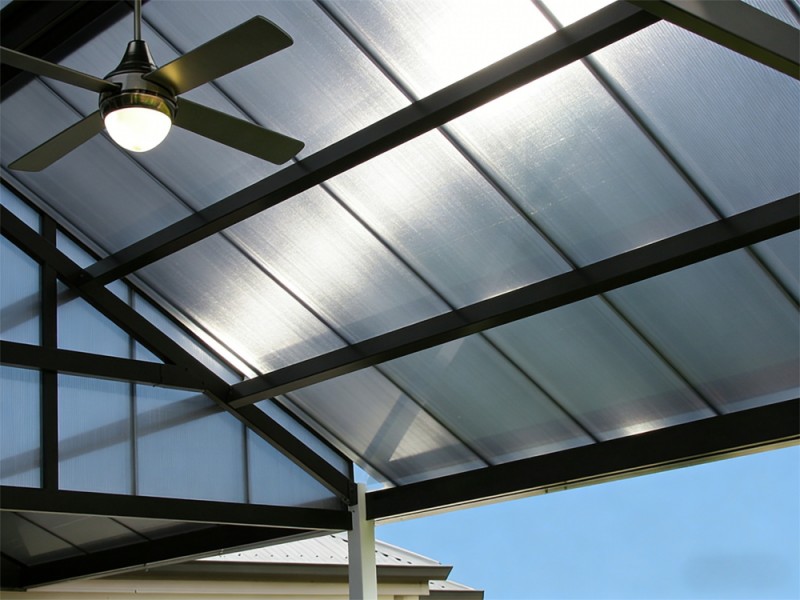
I. Core Environmental Data of the Middle East (Basis for Product Adaptation)
1. Extreme Climate Parameters
| Country | Maximum Annual Temperature (℃) | Maximum UV Intensity |
|---|---|---|
| Libya | 57.8 | 10 (Average peak in July) |
| Saudi Arabia | 54 | 12 (Peak value in Riyadh in May) |
| Iraq | 50 | 12 (Peak value in Najaf in May) |
| Algeria | 50 | 10 (Summer peak in Algiers) |
| Iran | 50 | No specific data available |
| Oman | 50 | No specific data available |
2. Temperature Difference Characteristics
The annual temperature difference ranges from 10℃ to 20℃, and the diurnal temperature difference is 15℃ to 30℃, exceeding 20℃ in desert areas.
Reference for thermal expansion and contraction: A 5.8-meter-long sheet will have a dimensional change of about 7.8mm under a 20℃ temperature difference. Calculation formula: 5.8 × 20 × 67.53 ÷ 1000 = 7.8mm.
II. Key Quality Improvement Recommendations
1. Selection of Raw Materials
Basic requirement: Adopt brand-new polycarbonate (PC) raw materials instead of recycled materials. Recycled materials contain degraded PC and impurities, which will reduce light transmittance, anti-aging performance and mechanical strength.
Recommended model: Lotte 1070U
Adaptation advantages:
- Built-in high-efficiency UV stabilizer to enhance light stability and weather resistance;
- Blocks intense ultraviolet rays and prevents sheet embrittlement and fracture caused by UV exposure;
- Ideal for long-term outdoor exposure in the Middle East and extends service life.

2. Optimization of UV Coating
Coating Thickness Standards
- For regular sun-exposed areas (coastal regions of Iran, Oman, etc.): Coating thickness ≥ 50μm;
- For extremely sun-exposed inland areas (Saudi Arabia, Iraq, etc.): Coating thickness ≥ 80μm;
- For structures exposed to sunlight on both sides such as roofs and canopies: Double-sided UV coating is mandatory.
Process Requirements
Adopt the in-line co-extrusion technology for UV coating to ensure firm bonding between the coating and the sheet. Strictly control extrusion temperature, speed and other process parameters to guarantee uniform coating thickness and avoid protection failure caused by uneven coating.
3. Weight Upgrade of Sheets (Exclusive Standard for the Middle East)
| Sheet Thickness | Standard Weight (KG/㎡) | Weight for Middle East (KG/㎡) | Increased Weight (KG/㎡) |
|---|---|---|---|
| 6mm Double-layer polycarbonate hollow sheet | 1.2 | 1.3 | 0.1 |
| 8mm Double-layer polycarbonate hollow sheet | 1.4 | 1.5 | 0.1 |
| 10mm Double-layer polycarbonate hollow sheet | 1.6 | 1.7 | 0.1 |
| 12mm Multi-layer polycarbonate hollow sheet | 2.0 | 2.1 | 0.1 |
| 16mm Multi-layer polycarbonate hollow sheet | 2.5 | 2.7 | 0.2 |
| 20mm Multi-layer polycarbonate hollow sheet | 3.0 | 3.2 | 0.2 |
| 25mm Multi-layer polycarbonate hollow sheet | 3.3 | 3.5 | 0.2 |
4. Color Selection
Recommended Colors
| Color | Core Advantages | Application Scenarios |
|---|---|---|
| Grey | Excellent heat insulation, dust concealment and good compatibility with surrounding environments | Sunshade canopies for parking lots, roofs of commercial buildings |
| Bronze | Better shading and heat insulation than light grey, outstanding UV resistance | Outdoor facilities in desert areas, roofs of industrial workshops |
| Milky White | Creates a cool visual effect with moderate UV protection | Park pavilions, landscape facilities and other leisure venues |
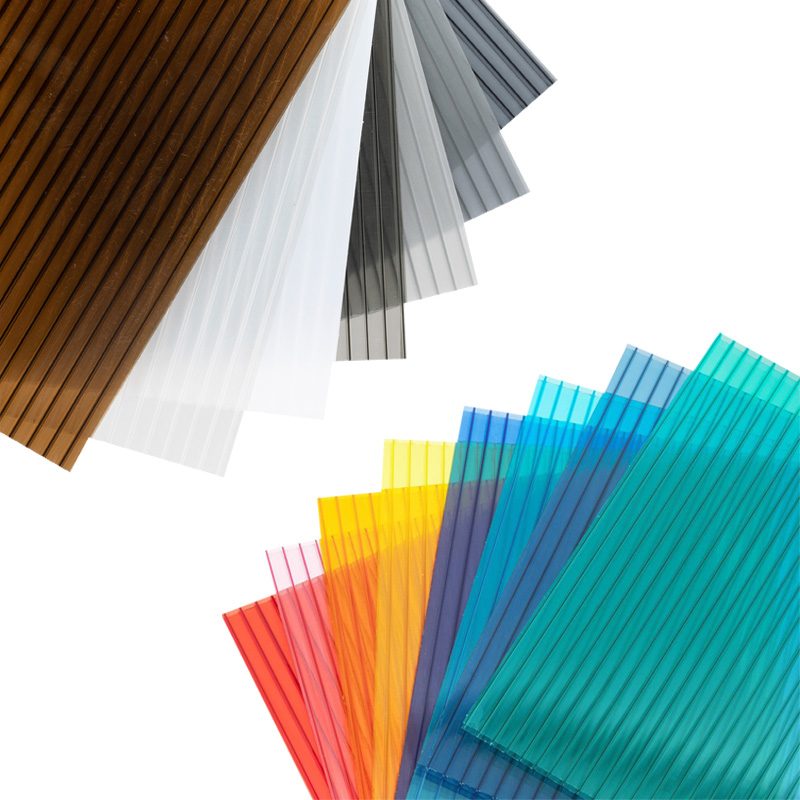
Color Card
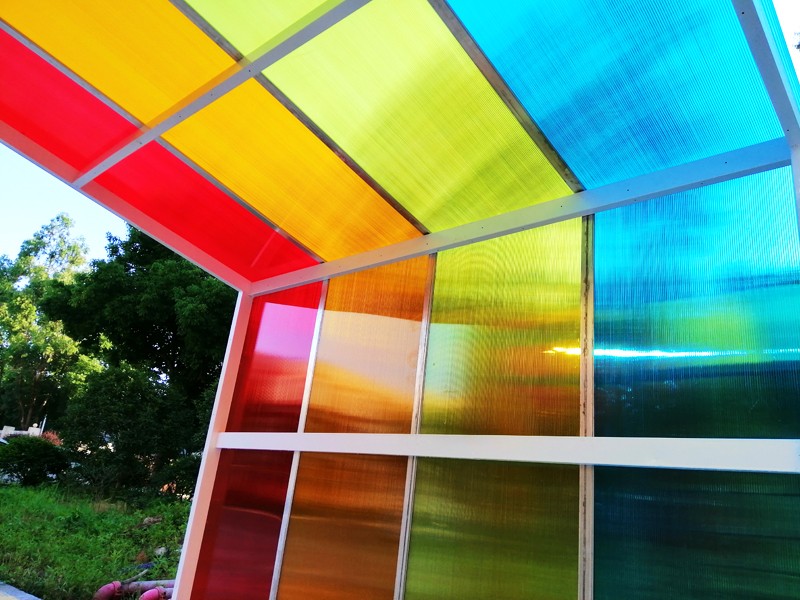
Outdoor reference colors:
Clear (A01#), Green (AC002#), Light Blue (AC003#), Dark Blue (AC004#), Light Bronze (AC005#), Dark Bronze (AC006#), Yellow (AC007#), Orange (AC008#), Dark Grey (AC009-1#), Silver Grey (AC009-2#), Pink (AC010#), White (AC011#), Red (AC012#)
5. Dimensional Control of Sheets (Adapted to Large Temperature Differences)
| Sheet Thickness | Recommended Size per Sheet | Design Concept |
|---|---|---|
| 6mm Double-layer polycarbonate hollow sheet | 1.22×5.8M | Balance coverage efficiency and reserved space for thermal expansion and contraction to prevent deformation caused by excessive length |
| 8mm Double-layer polycarbonate hollow sheet | 1.22×5.8M | Same as above |
| 10mm Double-layer polycarbonate hollow sheet | 1.22×5.8M | Same as above |
| 12mm Multi-layer polycarbonate hollow sheet | 1.05×5.8M | Multi-layer sheets feature higher rigidity; narrower width relieves installation stress |
| 16mm Multi-layer polycarbonate hollow sheet | 1.05×5.8M | Same as above |
| 20mm Multi-layer polycarbonate hollow sheet | 1.05×5.8M | Same as above |
| 25mm Multi-layer polycarbonate hollow sheet | 1.05×5.8M | Same as above |
6. Installation Requirements for Adaptation
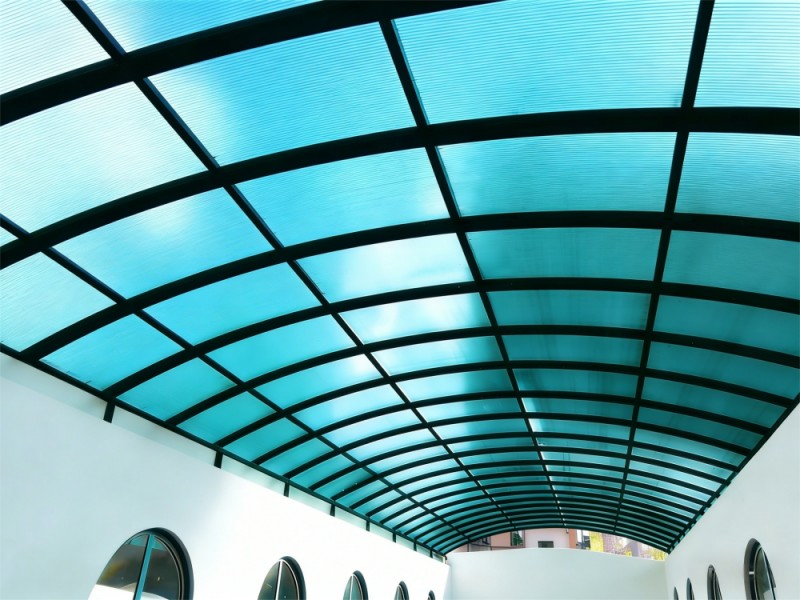
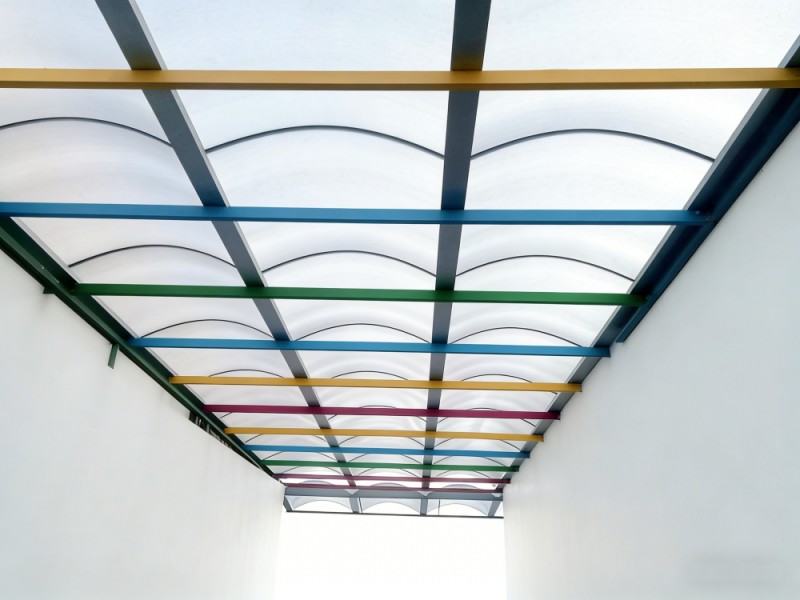
- Structural design: Arched canopy design is preferred to disperse stress generated by thermal expansion and contraction and avoid warping of flat sheets due to temperature changes.
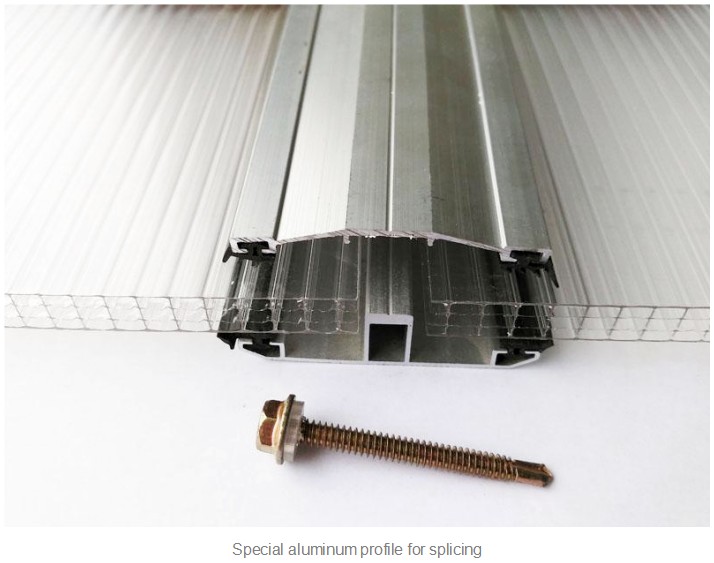
- Fixing method: Reamed holes are required for screw installation, with the hole diameter 2-3mm larger than the screw diameter to reserve expansion space. Use sliding aluminum pressure strips matched with EPDM sealing gaskets. Rigid fixing is prohibited, and a 2mm gap shall be reserved.
III. Aging Test Standards (Based on 6mm Clear Polycarbonate Hollow Sheet)
Detailed Test Results
| Test Duration (Hours) | Yellowness Index (YI) | Increased Yellowness Index (△YI) | Light Transmittance (%) | Reduced Light Transmittance (%) | Haze (%) | Increased Haze (%) |
|---|---|---|---|---|---|---|
| 0 | 1.4 | 0 | 81.8 | 0 | 30.4 | 0 |
| 350 | 1.5 | 0.1 | 81.2 | 0.6 | 33.1 | 2.7 |
| 500 | 1.7 | 0.3 | 80.9 | 0.9 | 33.5 | 3.1 |
| 1000 | 2.0 | 0.6 | 80.5 | 1.3 | 35.1 | 4.7 |
| 2000 | 3.9 | 2.5 | 79.4 | 2.4 | 36.5 | 6.1 |
| 3000 | 5.5 | 4.1 | 77.9 | 3.9 | 43.6 | 13.2 |
| 3500 | 6.7 | 5.3 | 77.5 | 4.3 | 46.3 | 15.9 |
| 4000 | 7.2 | 5.8 | 76.9 | 4.9 | 47.4 | 17.0 |
| 4500 | 7.7 | 6.3 | 76.3 | 5.5 | 49.2 | 18.8 |
| 5000 | 7.9 | 6.5 | 75.3 | 6.5 | 51.3 | 20.9 |
| 5500 | 9.2 | 7.8 | 74.8 | 7.0 | 54.9 | 24.5 |
| 6000 | 10.0 | 8.6 | 74.8 | 7.0 | 55.4 | 25.0 |
| 6500 | 10.0 | 8.6 | 74.4 | 7.4 | 60.5 | 30.1 |
| 7000 | 11.2 | 9.8 | 74.6 | 7.2 | 63.2 | 32.8 |
| 7500 | 12.4 | 11.0 | 75.1 | 6.7 | 63.5 | 33.1 |
| 8000 | 12.8 | 11.4 | 74.9 | 6.9 | 63.9 | 33.5 |
| 8500 | 15.1 | 13.7 | 70.3 | 11.5 | 68.4 | 38.0 |
| 9000 | 15.3 | 13.9 | 70.6 | 11.2 | 67.1 | 36.7 |
| 9500 | 16.5 | 15.1 | 71.4 | 10.4 | 67.6 | 37.2 |
| 10000 | 17.8 | 16.4 | 69.8 | 12.0 | 69.5 | 39.1 |
Recommended Indicators
After 2000 hours of aging test, the increased yellowness index is 2.5, which meets the standard of ≤3.0. The light transmittance decreases by 2.4% and haze increases by 6.1%, showing stable performance.
It is recommended to take the performance after 5000 hours of aging test as the core reference index for applications in the Middle East, so as to guarantee the long-term durability of polycarbonate hollow sheets.
![[Calculator] PC Hollow Sheet Weight & Volume](https://polyroofs.com/wp-content/uploads/2026/06/Polycarbonate-Hollow-Sheet2.jpg)

