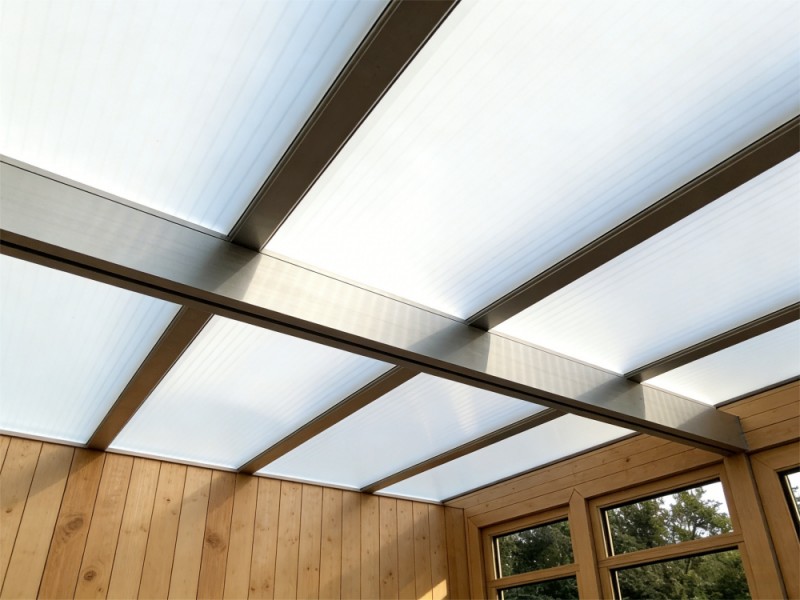
Light Transmission, Sound Insulation and Thermal Performance Table of Polycarbonate Sheet
Polycarbonate Sheet Light Transmission & Sound Insulation Performance Table
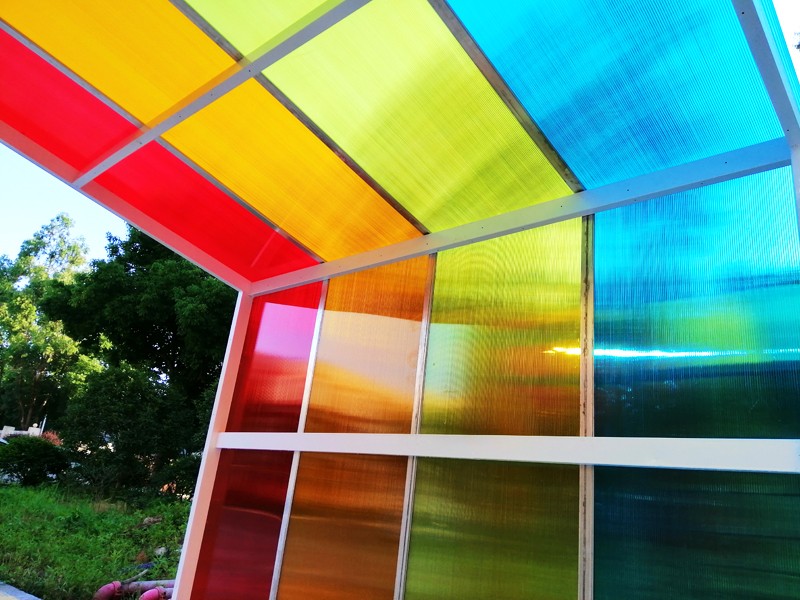
| Structure | Thickness (mm) | Clear | Bronze | Opal White | Royal Blue | Lake Blue | Grass Green | Sound Attenuation Value (dB) |
|---|---|---|---|---|---|---|---|---|
| Double-wall | 4 | 80 | 58 | 57 | 45 | 55 | 45 | 16 |
| Double-wall | 6 | 79 | 50 | 56 | 36 | 50 | 42 | 25 |
| Double-wall | 8 | 78 | 44 | 52 | 30 | 47 | 40 | 27 |
| Double-wall | 10 | 78 | 40 | 44 | 28 | 42 | 35 | 28 |
| Multi-wall | 12 | 75 | 38 | 42 | 25 | 40 | 34 | 30 |
| Multi-wall | 16 | 75 | 36 | 40 | 24 | 38 | 32 | 32 |
| Multi-wall | 20 | 72 | 35 | 38 | 23 | 35 | 31 | 34 |
Explanation of Sound Attenuation Value
- Double-wall structure
- 4mm: Deduced to 16dB based on the basic correlation between thickness and sound insulation;
- 6mm: 25dB referenced from measured data;
- 8mm: 2dB higher than 6mm, reaching 27dB;
- 10mm: 1dB higher than 8mm, reaching 28dB.
- Multi-wall structure
Thanks to more layers and complex hollow cavities, its sound insulation performance is 2–4dB better than double-wall sheets of the same thickness:
- 12mm: 2dB higher than 10mm double-wall sheet (28dB), reaching 30dB;
- 16mm: 2dB higher than 12mm sheet, reaching 32dB;
- 20mm: 2dB higher than 16mm sheet, reaching 34dB.
Calculated K-value (Thermal Insulation Coefficient) Table for Polycarbonate Sheet (4–30mm, Various Colours)
Notes:
- Data is calculated based on industry measured results and thickness variation rules plus colour influences, with a tolerance within ±5%.
- Unit of thermal insulation coefficient K-value: W/(m²·K). Lower K-value means better thermal insulation.
- Colour correction rule: Opal white & bronze sheets have 15% lower K-value than clear sheets with identical structure and thickness. Royal blue, lake blue and grass green sheets have 20% lower K-value.
| Structure | Thickness (mm) | Clear | Bronze | Opal White | Royal Blue | Lake Blue | Grass Green |
|---|---|---|---|---|---|---|---|
| Double-wall | 4 | 3.96 | 3.37 | 3.37 | 3.17 | 3.17 | 3.17 |
| Double-wall | 6 | 3.56 | 3.03 | 3.03 | 2.85 | 2.85 | 2.85 |
| Double-wall | 8 | 3.26 | 2.77 | 2.77 | 2.61 | 2.61 | 2.61 |
| Double-wall | 10 | 3.02 | 2.57 | 2.57 | 2.42 | 2.42 | 2.42 |
| Multi-wall | 12 | 2.78 | 2.36 | 2.36 | 2.22 | 2.22 | 2.22 |
| Multi-wall | 16 | 2.32 | 1.97 | 1.97 | 1.86 | 1.86 | 1.86 |
| Multi-wall | 20 | 1.69 | 1.44 | 1.44 | 1.35 | 1.35 | 1.35 |
| Multi-wall | 25 | 1.51 | 1.28 | 1.28 | 1.21 | 1.21 | 1.21 |
| Multi-wall | 30 | 1.32 | 1.12 | 1.12 | 1.06 | 1.06 | 1.06 |
Logic Description
- Benchmark K-value for clear sheets: Anchored by measured data of 6/8/10mm double-wall sheets and 16/20mm four-wall sheets. For double-wall sheets, each extra 2mm thickness reduces K-value by roughly 0.3–0.4. Multi-wall sheets feature more hollow chambers, delivering 15%–20% lower K-value than double-wall sheets of equal thickness. Above 20mm thickness, each extra 5mm cuts K-value by approximately 0.1–0.2.
- Colour: Following common industry rules, opal white and bronze sheets absorb partial heat, offering superior thermal insulation versus clear sheets. Darker royal blue, lake blue and grass green sheets absorb more heat for further improved insulation, hence the respective correction ratios of 15% and 20%.
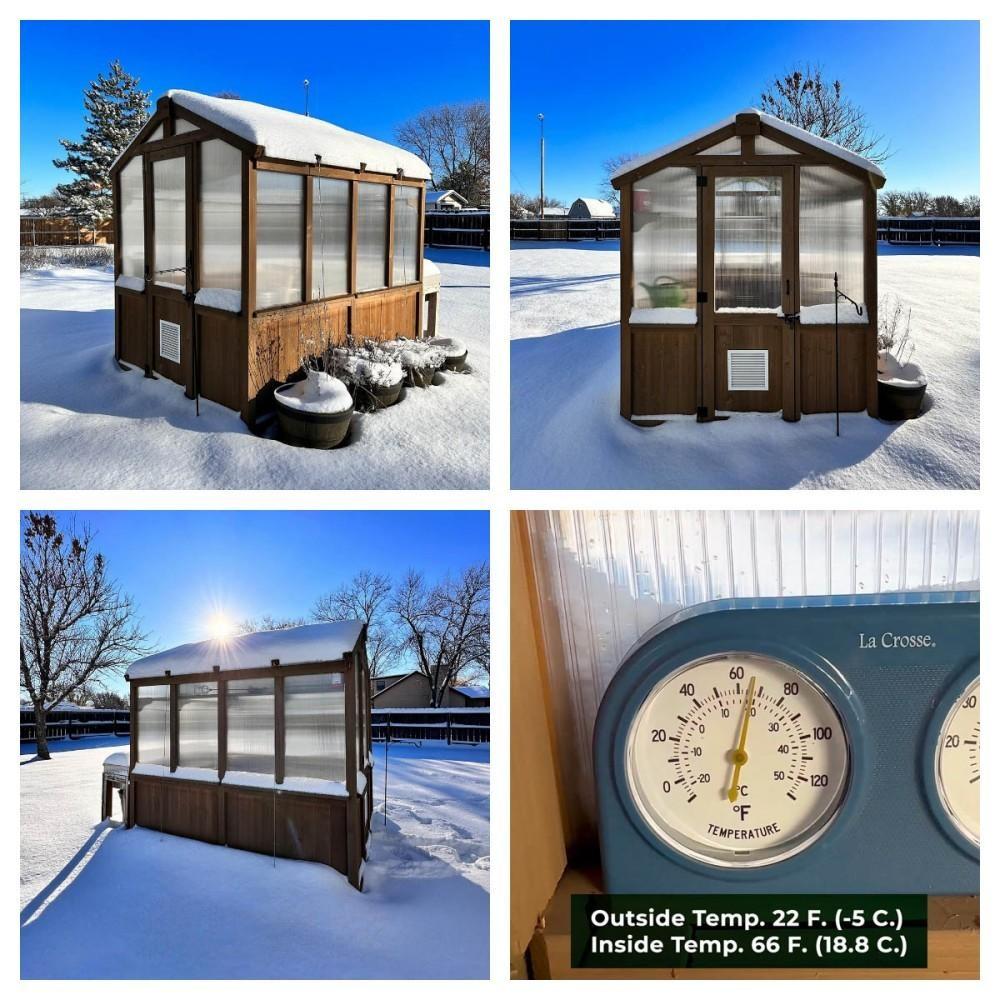
- Structural application: Double-wall polycarbonate sheets suit ordinary daylighting projects such as temporary carports and agricultural greenhouses. Multi-wall sheets excel in thermal insulation, ideal for buildings requiring high heat retention like commercial skylights and projects in coastal high-wind-pressure zones.
Disclaimer: All data is for reference only.